
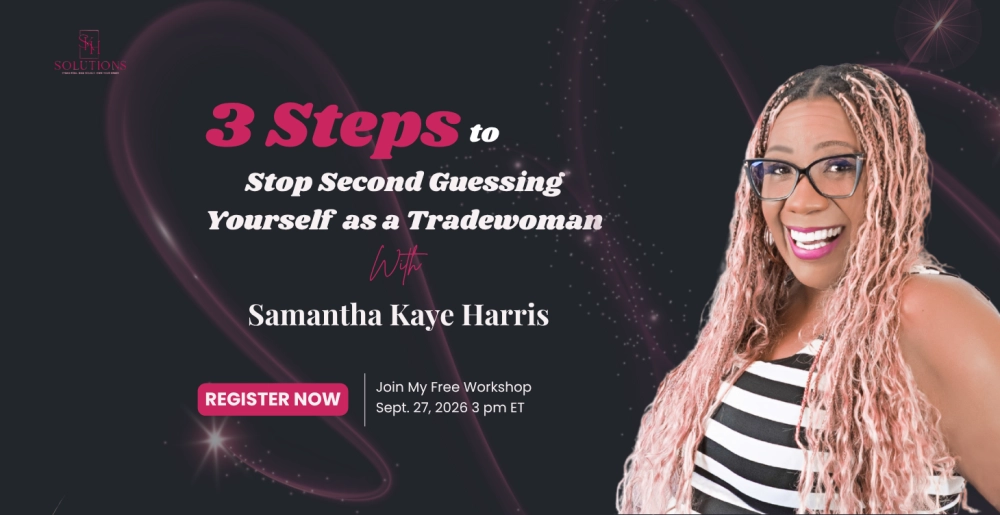
3 Steps
To Stop Second Guessing Yourself as a Tradeswoman
You have the skill. You have the knowledge. You have the certifications. Somewhere on that job site you stopped trusting that it was enough.
September 27th '26 | 🕒 3pm ET | 💻 Hosted Live on Zoom
Free, live, 90 minutes. Bring the situation that's been sitting on you.
What You'll Learn
⚪️ How to stop trying to be liked as a survival strategy, and stop chasing one more certification to prove something you already earned.
⚪️ How to say out loud what you bring, and keep a record of it, so you're not waiting on somebody's evaluation to tell you you're good.
⚪️ How to say what you do without leading with being a woman. They can see you're a woman. They need to hear what you can do.
What You Walk Away With
• You stop over-proving. You stop working twice as hard to earn a spot you already hold.
• You stop asking if you're good enough, and you stop paying for one more certification to prove something you already earned.
• You own what you do and how you do it... whether or not you get the certification, whether or not you get the job you put in for. That's what makes you unwavering.

ABOUT YOUR HOST
Hey. I'm Samantha Kaye.
I spent 27 years in the trades and 33 years at the same company. I came up from entry level and retired out of a leadership position, supervising crews of 102 tradespeople across multiple trades.
I know what those job sites feel like because I lived on them. I've been watched, questioned, talked over, and measured different than the men standing right next to me. And for a long stretch of those years I did what a lot of us do. I adjusted. I went quiet. I carried more and explained less, and I told myself that was just what it took to stay.
It wasn't. What it actually cost me was time, and I don't want it costing you the same.
Now I coach women in the trades, on the shop floor, and in tech to say what they bring without shrinking to do it. I'm also the founder of the Skilled Hands Foundation, helping women get into the trades in the first place, and I host the podcast Rooted in Your Confidence.
Why I’m Teaching This
• You stop second-guessing yourself mid-conversation. You stop knowing you had more to say and then talking yourself out of saying it. You stop walking off that job replaying the whole thing in your head, coming up with what you should have said three hours too late.
• You walk out of this class with the words. Not a pep talk, not a mindset shift you have to go home and figure out how to use. Actual language you can put in your mouth the next morning when somebody questions you, talks over you, or second-guesses work you already know is right.
• And you stop waiting. You stop waiting on somebody to notice you, to hand you the training, to tell you that you're good. You already know you're good. This is about saying it out loud in a room that was never built for you to say anything.